Over the last five years, I've done a few projects on Open Source, first at a strategy consultant firm and then for an enterprise software company. I've looked at Open Source from three primary frameworks: trying to describe it as an ecosystem, dissecting it as a business model and detailing it from a customer perspective. From these projects, its apparent that open source is not a monolith, it's different things to different people. This comment raises the hackles of some who object to the idea that Open Source is a "flavor" that can be injected into most anything a company does, not necessarily requiring an open source license.
Yes, I agree from a pure taxonomy standpoint, many of these things might not be "purely" Open Source. However, the Open Source label really doesn't mean much for a business or customer. Business or customers are after the results that open source can deliver to them, not open source itself.
Why this set-up? Because things aren't always what they seem. There are a lot of new companies out there branding themselves open source, but when you dissect their business model, they are really quite traditional. On the other hand, there are businesses out their that don't appear to embrace open source, but when you dissect their business models, they have surprising open source "flavor". If you heard there was a development community that had 500,000 members that contributed 80% of the content, you might think it was developed around an open source company? This actually referring to SAP's own development forum (SDN).
There is still a place to talk about open source as a classification. However, as a business or customer, the focus should be on the resulting benefits of open source. Business and customers are focused on development cost, quality, product cost, distribution, customization services, innovation and community support. In some cases, open source might be the best option, while in other cases traditional models are the right choice. The bottom line, though, is look beyond the models to what is actually delivered.
Saturday, May 20, 2006


Friday, May 12, 2006
Can the government actually do anything useful with telephone data?
Beyond the debate about whether the Government should be collecting phone record data is whether or not anything useful can come from the effort. An action can be right or wrong, independent of whether it is effective or ineffective. This post focuses on effectiveness; I'm not addressing legality.
A few years back, the idea of Total Information Awareness (TIA) was floated. The idea was shot down under the auspices of privacy, but many also felt that it was good in theory, but would yield limited practical results. This new data collection effort is a subset of what TIA aspired to do.
What the government seems to have collected from the phone companies is a lot of data around telephone calls ... Origin, destination, date/time and probably duration. This data in and of itself is not information. Information is the reduction of uncertainty that can be used in the decision making process. So what is the government doing with this data to turn it into information? The New York Times wrote, "Sen. Wayne Allard, R-Colo., said the NSA was using the data to analyze calling patterns in order to detect and track suspected terrorist activity, according to information provided to him by the White House."
I assume the government is applying a sophisticated version of Social Network Analysis to all of the data. Social Network Analysis can provide both forward looking and backward looking information. Forward looking analysis would be used to develop intelligence to disrupt a future action. Backward looking analysis would be used to identify the participants in an action that already took place. Both are useful to our intelligence and law enforcement community, but forward looking, preventive intelligence is more important to most Americans.
For Social Network analyses to be forward looking you need to put some filters around the data to isolate the networks that are useful. Without some filters it would be hard to isolate any useful patterns. I can't imagine that there would be emergent patterns in the phone data to allow identification of a home-grown attack. Yes, if there are calls to foreign countries, these would trigger suspicion, but planning for an attack would probably fit the same profile of calls that take place around planning a trip or a wedding. Some piece of information beyond just the call data is needed.
Although the government may not have received any identity information from the phone companies, this doesn't prevent it from merging identify information from other government databases with the telephone numbers to provide a rich data set. If this isn't possible, then I don't understand how the data could provide any forward looking, actionable intelligence.
A few years back, the idea of Total Information Awareness (TIA) was floated. The idea was shot down under the auspices of privacy, but many also felt that it was good in theory, but would yield limited practical results. This new data collection effort is a subset of what TIA aspired to do.
What the government seems to have collected from the phone companies is a lot of data around telephone calls ... Origin, destination, date/time and probably duration. This data in and of itself is not information. Information is the reduction of uncertainty that can be used in the decision making process. So what is the government doing with this data to turn it into information? The New York Times wrote, "Sen. Wayne Allard, R-Colo., said the NSA was using the data to analyze calling patterns in order to detect and track suspected terrorist activity, according to information provided to him by the White House."
I assume the government is applying a sophisticated version of Social Network Analysis to all of the data. Social Network Analysis can provide both forward looking and backward looking information. Forward looking analysis would be used to develop intelligence to disrupt a future action. Backward looking analysis would be used to identify the participants in an action that already took place. Both are useful to our intelligence and law enforcement community, but forward looking, preventive intelligence is more important to most Americans.
For Social Network analyses to be forward looking you need to put some filters around the data to isolate the networks that are useful. Without some filters it would be hard to isolate any useful patterns. I can't imagine that there would be emergent patterns in the phone data to allow identification of a home-grown attack. Yes, if there are calls to foreign countries, these would trigger suspicion, but planning for an attack would probably fit the same profile of calls that take place around planning a trip or a wedding. Some piece of information beyond just the call data is needed.
Although the government may not have received any identity information from the phone companies, this doesn't prevent it from merging identify information from other government databases with the telephone numbers to provide a rich data set. If this isn't possible, then I don't understand how the data could provide any forward looking, actionable intelligence.
Monday, May 01, 2006
"Flash Blog" Experiment With The Boston Marathon
The blogosphere, like most things, has taken on somewhat of a hierarchical structure. The A-list bloggers get most of the mindshare while most others are relegated to the "long tail". However, are there areas of the blogoshpere where A-list bloggers might not be in control of mindshare? The answer comes down to why people read blogs. The first reason is to be engaged in a community, whether it is around business or politics. A-list bloggers will probably always dominate this sphere. The second reason people read blogs is to find information on a specific topic. I believe it is here where the "long tail" can gain mindshare. To test this, I decided to run an experiment on something called a flash blog; a short-life blog on a limited topic. My hypothesis was that a short lifespan blog that provided real-time information around a time-limited event might grab some blogosphere mindshare.
This year's Boston Marathon provided a good base for the experiment. Wouldn't someone rather read a blog from a runner actually running the course than a journalist covering the event? The morning of the race, I launched a new blog with one introductory post. I then ran the marathon as a non-qualified runner (e.g., "bandit") and wrote 8 posts from my blackberry before and during the race. The day after the race, I posted a race wrap-up entry. Here is an analysis of the blog traffic, looking at returning visitors as a percentage of total visitors:
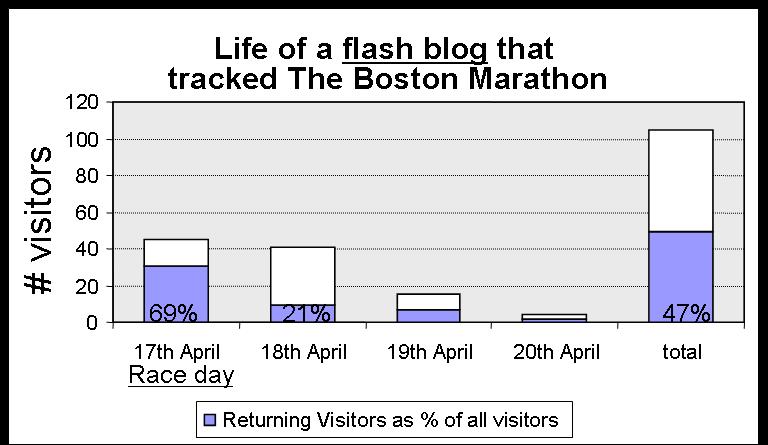
I did not completely "control" this experiment; I told four friends and co-workers about the blog, one who subsequently blogged about it on the day of the race and another who sent an email blast the day after the race. It's impossible for me to completely separate those who found this site through search versus those who were "pushed" the site, but from what I could tell, quite a few found the site through search. Here is what I took away from my quasi-experiment:
This year's Boston Marathon provided a good base for the experiment. Wouldn't someone rather read a blog from a runner actually running the course than a journalist covering the event? The morning of the race, I launched a new blog with one introductory post. I then ran the marathon as a non-qualified runner (e.g., "bandit") and wrote 8 posts from my blackberry before and during the race. The day after the race, I posted a race wrap-up entry. Here is an analysis of the blog traffic, looking at returning visitors as a percentage of total visitors:
I did not completely "control" this experiment; I told four friends and co-workers about the blog, one who subsequently blogged about it on the day of the race and another who sent an email blast the day after the race. It's impossible for me to completely separate those who found this site through search versus those who were "pushed" the site, but from what I could tell, quite a few found the site through search. Here is what I took away from my quasi-experiment:
- The blog's lifespan was intense and short. Traffic essentially dried up after the third day, with only sporadic visitors still coming. Readers understood the nature of the flash blog and its limited focus; they didn't come back expecting more content a week after the event.
- Readers fell into either a "real-time" or "wrap-up" category. "Real-time" readers read posts on the day of the race and were engaged, with ~69% of them returning to follow the progress. "Wrap-up" readers read all the posts after the race in one sitting with less repeat traffic.
- Reader commitment and participation was low. I believe that readers only wanted the "play by play" and nothing else. I received only a few comments and these were from acquaintances.
- Legitimacy was achieved by the fact that I was "on the ground". There was no other reason for people to read my posts. I provided no biographical data.
So, with any experiment, the key question is, what can flash blogs be used for? Here are a two thoughts:
- Provide focused, short term coverage with no commitment. Most blogs are perpetual and require some commitment from the writer and reader. Implicit in their build, flash blogs are casual and quick relationships, more akin to news articles. An individual can use them to provide one-off information on something he or she feels important about. A corporation can use them in its marketing plan for very short-term product launch coverage. To some extent, companies have been doing this.
- Use mindshare from a flash blog as an on-ramp to a perpetual blog. Taking advantage of traffic around a certain event, an individual could funnel the traffic to a perpetual blog. Readers gain because they "try out" the content before becoming a perpetual reader.
I'm sure others have tested these concepts more thoroughly and likely have ideas; I'd be interested to hear them.
Subscribe to:
Posts (Atom)